



A Hidden Mystery in the Heart of Gabon
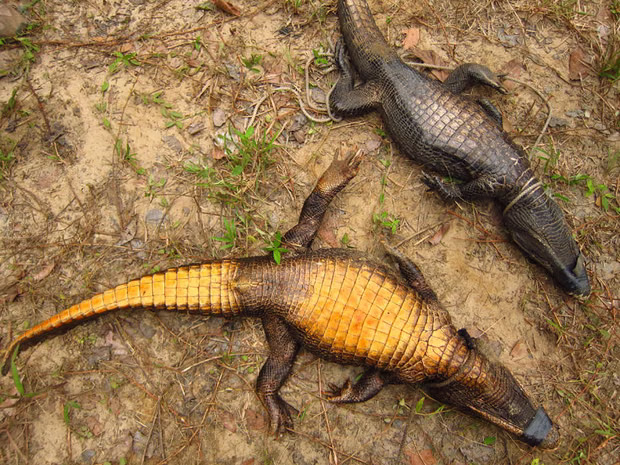
Deep within the lush tropical forests of Gabon, Central Africa, lies a cave that harbors one of nature’s strangest secrets. Known as Abanda Cave, this pitch-dark and humid chamber is home to thousands upon thousands of giant bats. Yet, it’s not the bats that have captured global fascination, but rather another resident lurking in the shadows: the African dwarf crocodile (Osteolaemus tetraspis). These crocodiles aren’t just smaller than their Nile or saltwater cousins—they are orange. Yes, instead of the familiar muddy green or brown, many of them gleam with a bizarre orange hue, creating a surreal sight in the dark corridors of the cave.
When photos of these orange crocodiles surfaced online, the world was baffled. Were these creatures an entirely new species? Had they undergone a rare genetic mutation? Or could this be an evolutionary adaptation to living in darkness? The questions multiplied as curiosity spread on social media, but the answers didn’t lie in internet theories. Instead, scientists set out to investigate, and what they uncovered was far more fascinating than anyone had guessed.
The Science Behind the Orange Glow
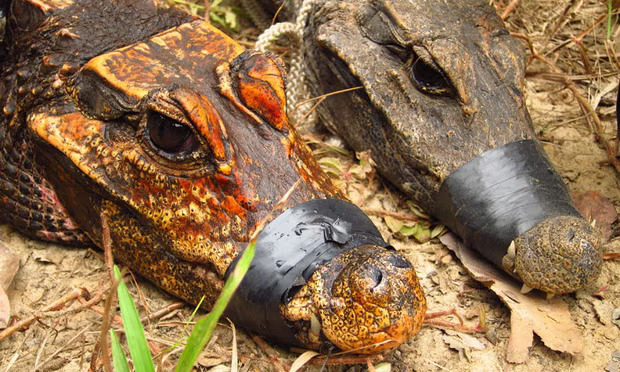
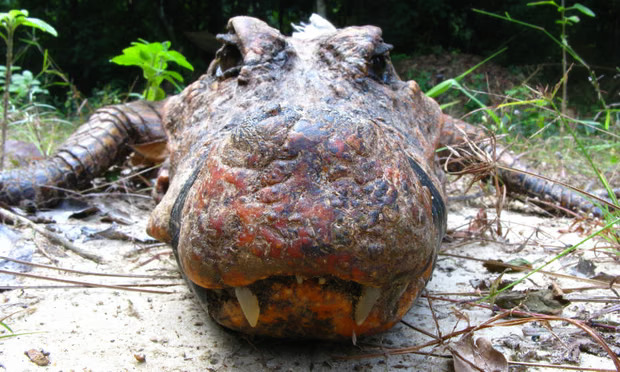
It turns out the orange color of these crocodiles has nothing to do with genetics. The truth lies in the environment. Abanda Cave is saturated with guano—the droppings of countless bats that carpet the cave floor in thick layers. Over time, this guano mixes with water, creating a unique, mineral-rich sludge. When the dwarf crocodiles wallow in it, the mud clings to their armored skin. Slowly, the chemical interactions between the guano and the crocodile’s scales change their color, staining them in varying shades of orange.
Field observations strongly back this explanation. Adult male crocodiles that spend long hours sitting in stagnant pools rich in guano are the ones with the most vivid orange coloring. By contrast, younger individuals or those that are more mobile often retain a more typical greenish-brown hue. In other words, the longer the crocodile stays in this guano-rich environment, the brighter its orange tint becomes. The effect is essentially environmental “makeup,” not an inherited trait.
Life in the Dark: Behavior and Diet
But the unusual appearance of these crocodiles is only part of the story. Life inside Abanda Cave has pushed them into a set of behavioral adaptations rarely seen in their kind. Unlike their surface-dwelling relatives, which feed on fish, crustaceans, and amphibians, the diet of the cave crocodiles is significantly different. Stomach content analysis revealed that these reptiles are opportunistic feeders, consuming small animals that share the subterranean ecosystem, many of them tied directly to the bat colonies above.
Even more surprising, researchers documented healthy juveniles living within the cave, proof that this bizarre ecosystem is capable of sustaining full life cycles. Despite the lack of sunlight, the abundance of organic material—largely fueled by bat droppings—creates a food web strong enough to support these top predators. For scientists, this was an astounding discovery: crocodiles not just surviving, but thriving in what most would consider an inhospitable environment.
Genetics: Isolation, Not a New Species
Naturally, the next question was whether these orange crocodiles represented a brand-new species. Genetic testing provided the answer. While the Abanda Cave population did show distinct haplotypes when compared to dwarf crocodiles outside the cave, the genetic divergence wasn’t large enough to classify them as a separate species. Instead, the evidence suggests that they are an isolated population that has been cut off from surface groups for a long time.
In taxonomy, declaring a new species requires more than genetic quirks. Morphological differences must also be present and consistently measurable. As of now, the Abanda cave crocodiles are still considered Osteolaemus tetraspis. However, the genetic uniqueness is enough for scientists to recognize them as a highly important and distinct group—one that could eventually evolve into something more if their isolation continues for millennia.
Conservation Challenges in a Fragile Ecosystem
The dwarf crocodile as a species is already classified as Vulnerable by the International Union for Conservation of Nature (IUCN). Across Africa, these reptiles face threats from hunting, habitat destruction, and wetland degradation. For the cave population, the risks are different yet equally urgent. Their survival hinges on the delicate balance of their subterranean ecosystem.
Protecting Abanda Cave means protecting the bats, since their guano sustains the food chain. It also means keeping the cave’s water sources clean and untouched by human pollution. With increasing curiosity and potential tourism interest in seeing the orange crocodiles, human disturbance could become a real problem. Too much interference could disrupt the bats, reduce guano deposits, or alter the fragile chemistry that sustains this system. Conservationists emphasize that any human activity in the cave should be tightly controlled to prevent ecological collapse.
Nature’s Strange Canvas
The story of the orange crocodiles of Abanda Cave is more than a curious footnote in natural history—it’s a vivid reminder of nature’s boundless creativity. What seems bizarre at first glance is actually the result of complex interactions between species and environment. Far from being mutants or mythical beasts, these crocodiles embody the resilience of life, adapting to conditions that defy normal expectations.
In many ways, the orange dwarf crocodiles are a living symbol of how much mystery still lies hidden in the world’s wild places. They challenge us to look deeper than surface appearances, to consider how ecosystems function in surprising, sometimes counterintuitive ways. And they highlight the urgent need to conserve these rare natural laboratories before human activity erases their secrets.
A Closing Reflection
So why are these crocodiles orange? The answer is simple and extraordinary at the same time: they live in a cave filled with bat guano, and the chemistry of that environment transformed them. But the deeper story is one of adaptability, survival, and ecological interconnection. These crocodiles didn’t evolve a new gene to turn orange. Instead, they allowed the environment to paint them—quite literally—into one of the most unusual sights in the animal kingdom.
The Abanda cave crocodiles remind us that nature’s most colorful wonders don’t always come from lush rainforests or coral reefs. Sometimes, they emerge from the darkest corners of the Earth, glowing orange in the shadows, waiting for us to discover and protect them.
