



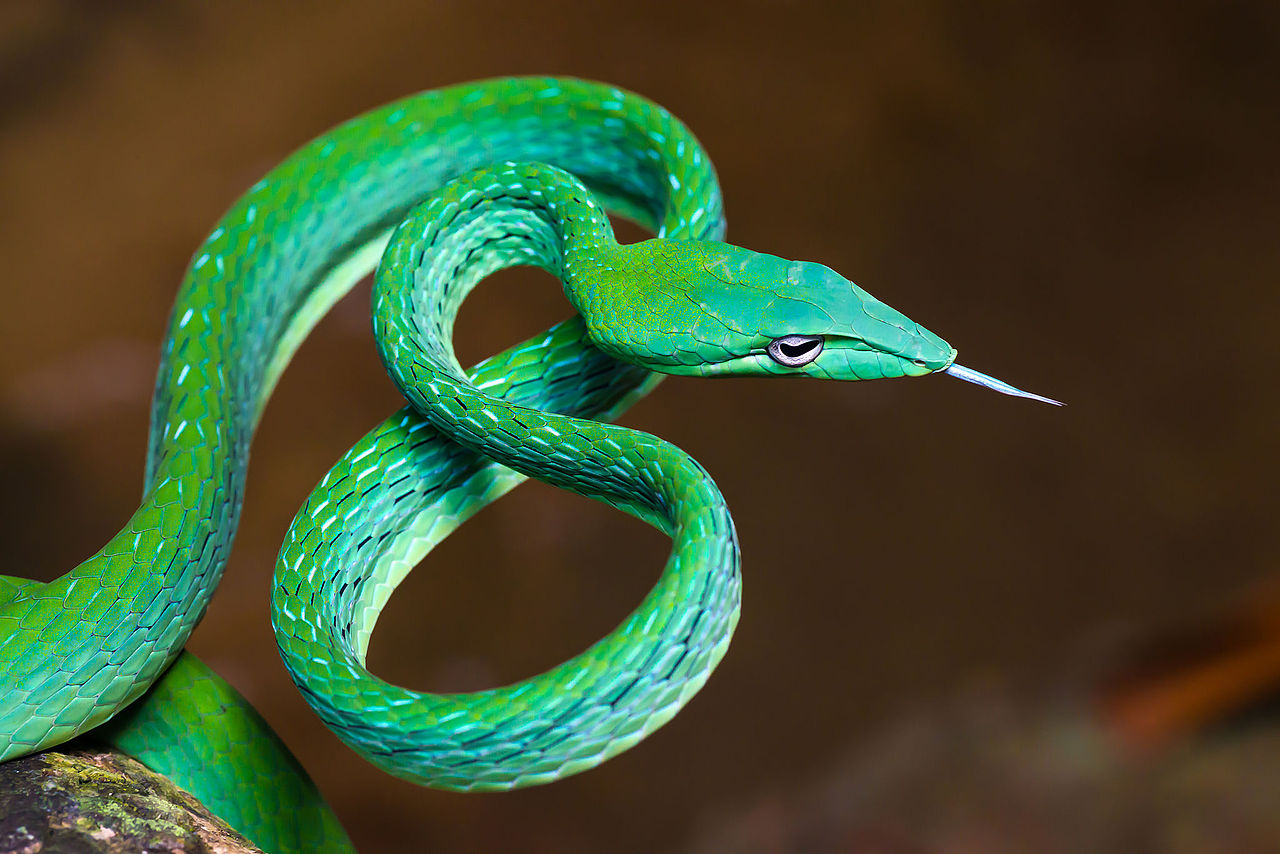
In the heart of Southeast Asia’s lush rainforests, there’s a silent spectacle happening high above the forest floor. Camouflaged among the branches, a snake stands completely still—so still that it’s almost indistinguishable from the surrounding twigs and vines. This isn’t a dead snake or one caught mid-motion. It’s asleep. Well, sort of.
Welcome to the incredible world of tree snakes like Boiga and Ahaetulla, masters of vertical living and strategic rest. These snakes have developed a mind-blowing behavior: “sleeping standing up.” It’s not a metaphor—these snakes wrap themselves tightly around a vertical branch and enter a state of rest, mimicking the appearance of a simple stick. This clever behavior is a powerful tool in their survival arsenal.
Sleeping Without Lying Down: Not Your Average Nap

Let’s be clear: when we talk about “sleeping” in snakes, we’re not referring to deep REM cycles like humans experience. Instead, it’s a form of passive rest or light torpor, where the snake’s metabolism slows, but awareness isn’t completely lost. In this state, they conserve energy without letting their guard down.
And while many animals curl up in safe, hidden spaces to rest, arboreal snakes do the opposite. They go vertical.
Super Snakes of the Canopy
Species like the Boiga dendrophila (gold-ringed cat snake), Boiga cyanea (green cat snake), and Ahaetulla prasina (Asian vine snake) are top-tier climbers. They spend most of their lives off the ground—navigating branches, hunting small animals, and avoiding predators. But one of their lesser-known skills is their ability to stay completely still in a vertical position for hours, clinging tightly to thin branches.
This behavior isn’t just impressive; it’s a biomechanical feat.
A 2015 study on snake biomechanics revealed that these species have specialized ventral muscles—think of them as internal belts—that clamp the underside of their body tightly to the branch. These muscles create a locking mechanism that doesn’t require the snake to constantly flex or burn energy to hold on.
In simpler terms: they grip without gripping.
It’s All in the Structure
But it’s not just the muscles. These snakes also have finely-tuned proprioception, which is the body’s ability to sense its position in space. It’s the same thing that lets you touch your nose with your eyes closed or walk in the dark without bumping into everything.
Tree snakes use this to adjust their grip without needing to see where they’re moving, making it easier to stay balanced even on the thinnest of perches. Their flexible spine, epaxial muscles, and elastic tissues work in harmony to maintain the illusion of being a motionless branch.
Field observations of Boiga cyanea in the forests of Thailand show these snakes adopting vertical positions for four to five hours during nighttime rest. Not only does this reduce visibility to predators, but it also puts them in a perfect ambush position should a small prey animal scurry beneath them.
Mastering Camouflage
Camouflage is everything in the wild. And when your survival depends on not being seen, becoming a stick might just be the ultimate disguise.
The Ahaetulla nasuta, for example, is a long, slender snake with a sharp-pointed snout. When it coils vertically around a branch, it perfectly mimics the shape, texture, and angle of a twig. Stay motionless long enough, and not even the most observant predator—or human—will spot you.
This form of mimicry is called masquerade camouflage, and it’s highly effective in leafy, cluttered environments like rainforests. Combine that with their green, brown, or even yellowish coloration, and these snakes basically vanish into their surroundings.
Staying Cool (or Warm)
There’s also a functional benefit beyond disguise: temperature regulation. By aligning vertically, these snakes can either expose less of their body to the sun during the day or increase their exposure to cooler night air depending on where they perch. This subtle positioning helps them maintain an optimal body temperature, a vital process for cold-blooded animals.
Since snakes can’t generate their own body heat like mammals, being able to passively regulate temperature by just shifting posture gives them a major survival edge—no need to waste energy on moving around.
When Camouflage Backfires
Ironically, their most brilliant survival strategy is also what makes them vulnerable. Because they look like branches or vines, these snakes are often accidentally stepped on, cut down, or killed by people walking through the forest or clearing vegetation.
In fact, several reports from Southeast Asian hiking trails describe snakes like Ahaetulla being found crushed or injured after blending too well with their surroundings.
Add to that the growing threat of the illegal exotic pet trade, and it’s clear these arboreal reptiles are facing serious challenges. Species with striking colors like Boiga cyanea are especially targeted, removed from the wild and sold as pets or collectors’ items—often without concern for their ecological importance.
According to TRAFFIC and IUCN reports, habitat fragmentation and poaching are accelerating population declines in many tree snake species across Asia.
Unsung Heroes of the Forest
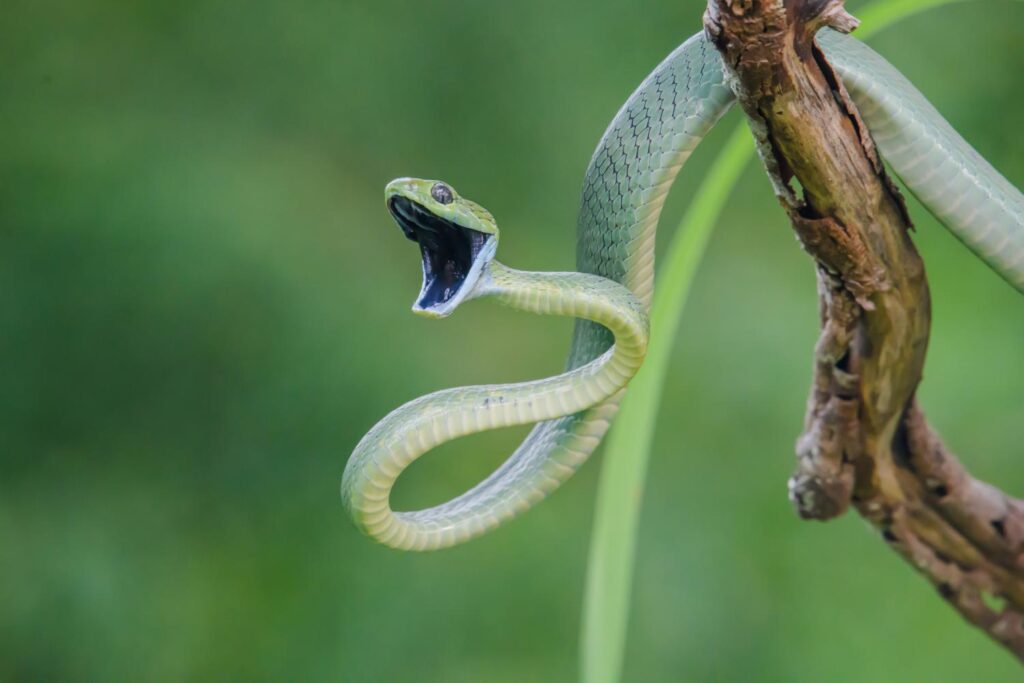
While some may shudder at the idea of snakes, these creatures play a vital role in forest ecosystems. They help control populations of birds, rodents, lizards, and insects—keeping the ecological balance in check. Without them, entire food chains could unravel.
What’s more, their presence is often an indicator of a healthy forest. When these snakes disappear, it’s a sign that something deeper may be wrong in the ecosystem.
Respect the Stick
Next time you’re hiking in Southeast Asia’s rainforests or scrolling through photos of exotic wildlife, take a closer look. That branch might have eyes. That vine might be breathing.
Tree snakes have evolved a stunning combination of biology, behavior, and biomechanics to survive in one of the most complex environments on Earth. Their ability to “sleep standing up” isn’t just a quirky habit—it’s a survival strategy forged by millions of years of evolution.
But even the most advanced strategies can’t protect them from the threats of habitat destruction, ignorance, or illegal trade.
If we want to keep witnessing such incredible examples of adaptation and evolution, we must protect their forests, ban illegal trafficking, and educate others on the beauty of these misunderstood creatures.
Because sometimes, the best way to stay alive is to stand perfectly still—and disappear.
