



In a world where survival often means running, hunting, or hiding, the African lungfish has mastered a completely different strategy: doing absolutely nothing. No movement. No food. No water. Just stillness in the mud—and a whole lot of patience. This fish, known scientifically as Protopterus, takes “tough” to a whole new level. It can live without water not just for a few days or weeks, but for months—and in some cases, even years.
Sounds like science fiction? It’s not. It’s called estivation, and it’s a real biological phenomenon. So real, in fact, that researchers at NASA and top universities are studying it for applications in space travel and medicine. Let’s dive deep (pun intended) into the incredible life of the African lungfish—a slippery little evolutionary miracle from the mudflats of Africa.
Meet Protopterus: The African Lungfish

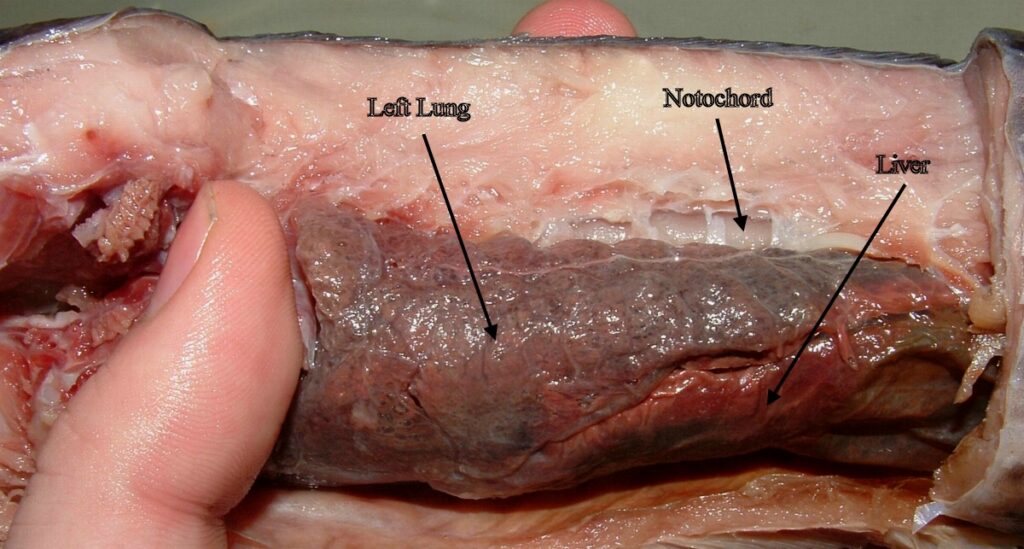
The African lungfish looks pretty ordinary at first glance—long, slimy, eel-like, and often hiding in murky water. But don’t be fooled. This prehistoric-looking fish is an evolutionary anomaly and a true biological marvel. It doesn’t just breathe through gills like most fish. It has lungs—yes, real, functioning lungs—that allow it to breathe air.
There are four species of African lungfish (Protopterus annectens, P. dolloi, P. aethiopicus, and P. amphibius), all native to freshwater environments across Africa. And what sets them apart from just about every other fish on Earth is their ability to survive complete drought.
When their habitat dries up during the long, harsh African dry seasons, the African lungfish doesn’t panic. It simply digs itself into the mud, wraps itself in a protective mucus cocoon, slows its metabolism down to a crawl—and waits.
What Is Estivation? Hibernation’s Hot Cousin
If you’ve heard of hibernation, you already have a general idea of what estivation is. But while hibernation helps animals survive cold, estivation is all about surviving heat and dryness. It’s basically a biological power-saving mode.
For the African lungfish, estivation isn’t just a short nap. It’s a deep, transformative process that can last from 4 to 6 months—and in some documented cases, up to 4 years. During this time, the fish doesn’t eat, move, or even breathe very often. Its metabolic rate drops to 1/60th of its normal activity.
To protect itself, the fish secretes mucus from its skin that hardens into a kind of biological sleeping bag. A small hole in the mud allows it to breathe air using its lungs, while it lies perfectly still underground, conserving every last drop of energy.
The Science Behind the Survival

So, how does the lungfish do it? What’s happening inside its body during this extreme dormancy?
Here’s a simplified breakdown:
- Mucus Cocoon: Acts as a physical barrier to dehydration and infection.
- Metabolic Shutdown: The fish essentially powers down like a laptop in sleep mode. No eating, minimal cellular activity.
- Nitrogen Waste Conversion: Most fish excrete ammonia into water. But with no water around, the lungfish converts ammonia into urea, which is far less toxic and can be safely stored in the body.
- Genetic Activation: Studies show that specific genes related to cell protection and antioxidant defense—like heat shock proteins (HSPs)—get activated to prevent cellular damage.
According to researchers at the National University of Singapore and University of Guelph, even after six months of estivation, these fish show no permanent damage. It’s like hitting pause on life and walking away—only to resume right where you left off.
A Biological Bridge to the Past
Lungfish aren’t just survivors—they’re living fossils. Their anatomical features suggest that they’re the closest living relatives of tetrapods—the group that includes amphibians, reptiles, birds, and mammals (yup, that includes us humans). Their lobed fins and primitive lungs represent the very adaptations that may have allowed fish to first crawl onto land millions of years ago.
So when we look at a lungfish, we’re not just seeing a cool fish. We’re seeing an evolutionary missing link. A glimpse into the past, preserved in slime and mud.
From Mud to Medicine: Lungfish and Science
Estivation isn’t just a fascinating curiosity—it has real-world implications. Researchers are exploring how this extreme dormancy might inspire breakthroughs in medicine and space exploration.
Imagine if doctors could induce a similar low-energy state in humans during surgeries or transplants. What if astronauts could “hibernate” during months-long missions to Mars to save energy and reduce resource use?
NASA scientists are studying the lungfish’s biology for exactly these reasons. Their survival without food, water, or movement offers a model for suspended animation—a state where the body is preserved in a dormant, low-metabolic condition.
Any Indonesian Equivalents? Not Quite
You might be wondering: do we have anything like this in Indonesia? The answer is… almost, but not quite.
The Clarias batrachus, or the walking catfish, can survive in low-oxygen environments and even wriggle over land thanks to its accessory breathing organs. It’s tough and adaptable—but it doesn’t estiv. It doesn’t create a cocoon or slow its metabolism to the same extreme degree as the African lungfish.
Some freshwater fish in Indonesia show signs of metabolic adjustment in dry or hypoxic environments, but none come close to the full-blown estivation strategy of Protopterus. In that sense, the African lungfish still reigns supreme as the undisputed master of dormancy.
The Sleepy Fish That’s Wide Awake in Science
The African lungfish may not win any beauty contests, but in the world of survival, it’s a rockstar. From outlasting droughts for years to providing a living model for future space travelers, this ancient fish has a lot to teach us.
Its ability to enter estivation—a state of prolonged, life-suspending rest—challenges what we know about biology and survival. And while we may never nap our way to Mars, this slimy survivor from Africa proves that sometimes, the smartest way to endure a harsh world is simply to wait it out.
