



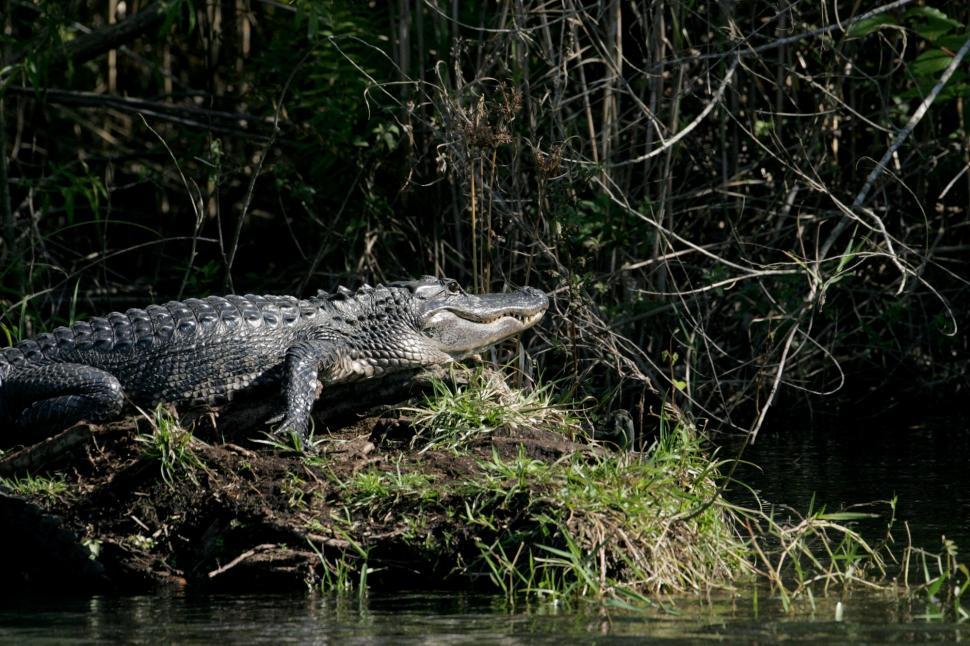
For centuries, crocodiles have been painted in stories, myths, and films as lurking predators of the water. They belong to swamps, rivers, and lakes — heavy-bodied reptiles that ambush their prey from the muddy banks or just beneath the surface. The idea of a crocodile climbing anything, let alone balancing on a tree branch, feels absurd at first. After all, they are prehistoric giants with short legs and heavy frames, not agile creatures built for the heights.
And yet, nature has a habit of surprising us. Over the past decade, researchers and wildlife observers have documented something that once sounded like tall tales: crocodiles and alligators climbing trees. Not just hauling themselves up muddy banks, but scaling angled trunks and perching on branches several meters above the ground or water.
What sounds like fiction has now been backed by photographs, studies, and repeated sightings from Africa to Australia. It’s a reminder that crocodiles, survivors of millions of years of evolution, have a few tricks left up their scaly sleeves that we’re only just beginning to understand.
The First Shocking Sightings
Imagine kayaking down a river, scanning the banks for crocodiles, only to look up and see one stretched out across a tree branch above your head. That’s exactly what startled birdwatchers, tourists, and researchers reported in places as far apart as Zambia, Florida, and northern Australia.
For years, such claims were brushed off as mistaken identity or exaggeration. A dark branch could look like a crocodile from the wrong angle, and the idea was simply too strange to take seriously. But then came the hard evidence.
In 2014, a study led by Dr. Vladimir Dinets of the University of Tennessee, published in Herpetology Notes, provided clear documentation. Using field observations and photographs, Dinets and his colleagues showed that both crocodiles and alligators were capable of climbing tree trunks or branches as high as four meters. These weren’t rare, one-off incidents either — the behavior was recorded across continents.
That discovery didn’t just rewrite part of what we know about crocodile behavior. It also reminded us of a key truth: animals often behave in ways that don’t fit neatly into our human assumptions.
Why Would a Crocodile Climb a Tree?
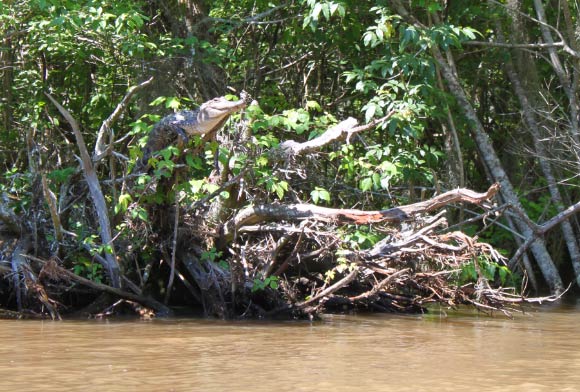
The big question is: why bother? Crocodiles are cold-blooded reptiles, meaning they rely on external heat sources to regulate their body temperature. Basking in the sun is critical for their survival, and they usually do this on riverbanks or sandbanks. But what happens when those spots are shaded, flooded, or overcrowded with other crocodiles?
That’s where trees come in. A low, angled trunk or branch bathed in sunlight makes the perfect basking platform. From there, a crocodile can warm itself efficiently without competing for space on the ground.
There’s also a strategic advantage. Perched above the water, crocodiles enjoy a wide view of their surroundings. They can scan for prey, watch for threats like humans, or simply keep tabs on other crocodiles. And if danger approaches? They can launch themselves into the water in seconds, often before an observer even realizes what’s happening.
Interestingly, some researchers think tree-climbing might also serve a social purpose. Crocodiles compete fiercely for basking spots on the ground. By climbing into trees, an individual can avoid confrontation with larger rivals, giving it a peaceful place to rest. In that sense, climbing is not just about thermoregulation but also about navigating the social dynamics of crocodile life.
The Young Are the Real Daredevils
When it comes to tree climbing, size matters. Young crocodiles are the most enthusiastic climbers, often seen perched several meters above the ground. Their smaller, lighter bodies make it easier to scramble up angled trunks, and the branches can support them without snapping.
Reports from Mexico and Colombia describe juvenile crocodiles perched as high as nine meters in the trees — a mind-boggling image when you picture these toothy reptiles usually lurking at water level.
Adults, on the other hand, are more limited. Their bulk makes climbing more difficult, and branches that could hold a 50-pound youngster would never support a 500-pound adult. Still, that doesn’t mean big crocs don’t climb. In Africa and Australia, even saltwater crocodiles (Crocodylus porosus) — which can reach over six meters in length — have been documented hauling themselves onto low trunks that jut over rivers. They may not climb as high, but their presence in the trees is intimidating enough.
The difference highlights an important survival strategy. Young crocodiles are vulnerable to predation from larger crocs, birds of prey, and mammals. By climbing, they escape threats and gain safer basking spots. Adults, already dominant predators, don’t need that level of protection. For them, a low branch offers nothing more than a convenient sunbed.
How Do They Even Do It?

At first glance, crocodiles seem totally unsuited for climbing. Short legs, heavy torsos, long tails — none of these features scream agility. They lack gripping claws like cats, prehensile tails like monkeys, or the nimble leaps of lizards that specialize in arboreal life. So how on earth do they manage?
The answer lies in brute strength and the right environmental setup. Crocodiles typically climb angled trunks or branches that slant low over the water, not sheer vertical trees. Using their powerful hind legs, muscular tails, and even the rough texture of their bellies for traction, they can inch their way up surprisingly steep inclines.
It’s not graceful. Watching a crocodile climb is more like watching a log heave itself uphill than a squirrel darting through branches. But slow and steady wins the race. Once they reach a branch, crocodiles simply sprawl out and remain still, blending into the environment. From a distance, they can look like nothing more than a dark lump of wood — which is precisely why many human observers have missed them until it’s too late.
A Worldwide Phenomenon
The most striking thing about crocodile tree-climbing is how widespread it is. This isn’t a quirky behavior limited to one species or one location.
In Africa, Nile crocodiles (Crocodylus niloticus) and slender-snouted crocodiles (Crocodylus cataphractus) have been spotted perched on riverbank trees in Ghana, Zambia, and Uganda. In the Americas, American crocodiles (Crocodylus acutus) and American alligators (Alligator mississippiensis) have been photographed resting in mangrove branches. One Colombian sighting reported a young crocodile nearly nine meters up in the canopy — possibly the highest ever recorded.
Asia-Pacific has its share of climbers too. In Papua and northern Australia, the massive saltwater crocodile has been seen lounging on low trunks overhanging tidal creeks and mangrove swamps. These sightings prove that the ability is not just a fluke of one environment but an adaptive behavior across multiple continents and species.
This global consistency suggests that climbing may be a common yet underreported aspect of crocodile behavior. After all, most people look for crocodiles at water level, not above their heads. How many times have crocodiles gone unnoticed simply because we weren’t looking up?
What It Means for Humans
For generations, local communities in Africa and Asia passed down advice: if you’re being chased by a crocodile, climb a tree. At ground level, humans stand little chance against the explosive speed and power of a croc, but in a tree, you’d supposedly be safe.
The reality? Not so simple anymore. While you’re still safer up a tall, straight tree that offers no angled branches, the myth of trees as guaranteed refuges is officially debunked. In some regions, the very trees people might scramble into are the same ones crocodiles use as sunning platforms.
That doesn’t mean crocodiles are waiting in trees to ambush humans — there’s no evidence of that. But it does mean river travelers, fishermen, and adventurers should think twice before assuming that above-ground always means out of reach.
Crocodiles as Survivors and Adapters
The fact that crocodiles can climb at all is yet another reminder of why they’ve survived virtually unchanged since the age of dinosaurs. Their reputation as “living fossils” sometimes makes us think of them as static creatures locked into rigid behaviors. In truth, crocodiles are flexible, opportunistic, and highly adaptive.
They don’t just lurk at the water’s edge; they patrol oceans, navigate freshwater rivers hundreds of miles inland, and now we know — they even explore vertical space. Whether it’s warming their bodies, avoiding rivals, or simply finding a quieter place to rest, crocodiles have learned to make the most of their environments in ways we’re still discovering.
And perhaps that’s the biggest lesson of all: when it comes to ancient predators, never underestimate what they might be capable of.
The Startling Image That Stays With You
It’s one thing to read about crocodiles in trees. It’s another to picture it — a reptile that can grow longer than a car, covered in scales, lined with teeth, stretched out on a branch like some oversized iguana. It’s equal parts comical and terrifying.
For wildlife lovers, it’s also deeply fascinating. Crocodiles represent resilience, mystery, and the enduring unpredictability of nature. Just when we think we know their limits, they reveal another adaptation, another hidden behavior, another way of surviving that defies our expectations.
So next time you’re on a river in Africa, Asia, or the Americas, don’t just scan the water’s surface. Look up. Because somewhere above you, a crocodile might be sunning itself, reminding us that in the wild, reality is often stranger than fiction.
Final Thoughts
Tree-climbing crocodiles may sound like a bizarre footnote in the story of these ancient predators, but the phenomenon is far from trivial. It challenges our assumptions, broadens our understanding of their ecology, and forces us to rethink how crocodiles interact with their environments.
They are not simply water-bound ambush hunters but versatile reptiles capable of adapting to multiple challenges. From riverbanks to tree branches, their behavior underscores the evolutionary resilience that has kept them thriving for millions of years.
And in the end, maybe that’s the real takeaway: if crocodiles can climb trees despite their ungainly bodies, then our picture of the natural world is still incomplete. The wild continues to surprise us — and crocodiles, in their ancient wisdom, continue to remind us why we should never stop looking closer.
