

Close Menu
Saibumi | Uncovering Asia, One Story at a Time
    What's Hot

    Indonesia’s National Nutrition Agency Leadership Change Draws International Attention

    June 3, 2026

    Indonesia’s Biodiesel Shift: B50 Plan Put on Hold, Raising Questions for Global Palm Oil Markets

    January 14, 2026

    Elephants Help Clear Wooden Debris After Aceh Disaster

    December 27, 2025
    Facebook X (Twitter) Instagram
    Saibumi | Uncovering Asia, One Story at a TimeSaibumi | Uncovering Asia, One Story at a Time
    • About Us
    • Contact Us
    • Advertise
    Facebook X (Twitter) Instagram YouTube LinkedIn Reddit
    • Home
    • Stories

      The Global Plastic Treaty Fails Again – What Does It Mean for the Planet?

      August 27, 2025

      Puru Kambera Savanna: Tracing the Wild Horses of East Sumba

      August 25, 2025

      West Sumatra Emerges as a Leading Muslim-Friendly Travel Destination

      August 24, 2025

      Tabola Bale Song: The Viral Music Blend From Eastern Indonesia

      August 20, 2025

      Tanjung Karang Beach: An Underwater Paradise in Donggala

      August 20, 2025
    • Travel

      Know the Types of Snakes in the Wild & What to Do If You Get Bitten

      December 27, 2025

      Thailand Named the Best Food Country in the World 2025 — Beating Italy and Japan

      October 14, 2025

      Dieng Plateau Officially Designated as Indonesia’s Newest National Geopark

      September 29, 2025

      The Culture of Souvenirs: How Indonesians Strengthen Workplace Relationships Through Oleh-oleh

      September 29, 2025

      6 Best Coffee Shops in Asia – And Yes, One of Them Is in Indonesia!

      September 28, 2025
    • Culture
    • Lifestyle
      1. Food & Culture
      2. Green Living
      3. Local Life
      4. Modern Living
      5. People & Inspiration
      6. View All

      Gen Z in Indonesia and the Global “Escape Culture”: Why Many Are Saying #KaburAjaDulu

      October 20, 2025

      The Export of Indonesian Specialty Products: How Local Ingredients Are Becoming Global Brands

      October 20, 2025

      From Training to Takeoff: MKP’s Approach to Responsible Worker Preparation

      October 18, 2025

      Thailand Named the Best Food Country in the World 2025 — Beating Italy and Japan

      October 14, 2025

      List of Plants That Attract and Repel Snakes Around the House

      October 20, 2025

      Bird-Friendly Coffee in Lampung: Wild Birds Help Farmers Control Pests Naturally

      September 23, 2025

      Standing Still Like a Stick: How Tree Snakes Outsmart Predators with Vertical Sleep

      July 17, 2025

      Not a Cat, Not a Snake — Meet the Plant That Can Eat Rats

      July 12, 2025

      #KaburAjaDulu: When Young Indonesians Feel Like Escaping Is the Only Way to Survive

      October 9, 2025

      The Culture of Souvenirs: How Indonesians Strengthen Workplace Relationships Through Oleh-oleh

      September 29, 2025

      How Remote Work and Digitalization Are Transforming Indonesian Work Culture

      September 28, 2025

      Staying Healthy in Unpredictable Weather: Indonesian Habits the World Can Learn From

      September 21, 2025

      Gen Z in Indonesia and the Global “Escape Culture”: Why Many Are Saying #KaburAjaDulu

      October 20, 2025

      Indonesia’s Beauty Industry Is Having a Major Glow-Up

      July 1, 2025

      Why Indonesian Coffee Is the Next Big Thing Among Global Freelancers

      June 30, 2025

      The Culture of Souvenirs: How Indonesians Strengthen Workplace Relationships Through Oleh-oleh

      September 29, 2025

      The Indonesian Work Culture: Harmony and Gotong Royong in Action

      September 16, 2025

      Southeast Asian Solidarity: Citizens Rally Behind Indonesian Protesters Amid Police Violence

      September 6, 2025

      What Germans Can Learn from the Philosophy of Gotong Royong

      July 16, 2025

      Gen Z in Indonesia and the Global “Escape Culture”: Why Many Are Saying #KaburAjaDulu

      October 20, 2025

      #KaburAjaDulu: When Young Indonesians Feel Like Escaping Is the Only Way to Survive

      October 9, 2025

      The Indonesian Work Ethic: Why Global Teams Trust Indonesian Professionals

      October 2, 2025

      Why Indonesian Talents Are the Best Choice for Global Companies

      October 2, 2025
    • Local Business
    Subscribe
    Saibumi | Uncovering Asia, One Story at a Time
    Home » The Mysterious Sea Dragon: Oarfish, the Doomsday Fish from the Depths
    Don't Miss

    The Mysterious Sea Dragon: Oarfish, the Doomsday Fish from the Depths

    Editor DeskBy Editor DeskAugust 25, 2025Updated:August 25, 2025No Comments8 Mins Read
    Facebook Twitter Pinterest LinkedIn Tumblr Email
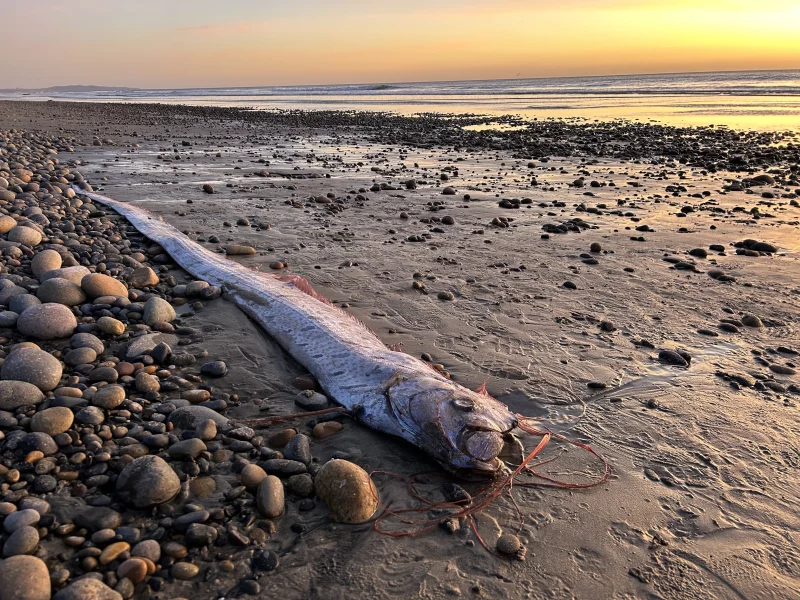
    Foto : mangobay.co.id
    Share
    Facebook Twitter LinkedIn Pinterest Email Copy Link

    Few ocean creatures have fueled human imagination as much as the oarfish. Known in Indonesia as ikan sabuk or “belt fish” due to its long, ribbon-like body, this enigmatic animal has earned legendary nicknames across the globe. In some cultures, it’s called the sea dragon, shimmering like a mythological serpent gliding through the deep. Even more chilling, many Asian traditions call it the “doomsday fish,” a name born from the belief that its rare appearances foretell disasters.

    These titles are not without reason. The oarfish is the longest bony fish in the world, with recorded specimens stretching beyond 36 feet (11 meters). Its silvery, slender body and crimson dorsal fin give it a ghostly, almost otherworldly appearance. Because sightings are extremely rare—whether at the ocean’s surface or washed up on shore—its presence has long carried an aura of mystery, blending science, myth, and fear.

    But despite its terrifying reputation, the oarfish is no sea monster. It’s not a predator like sharks or tuna. Instead, it survives on plankton, tiny crustaceans, and miniature squid. That contradiction—an enormous, dragon-like fish living on microscopic prey—only makes it more fascinating. How can a creature the length of a tour bus thrive on such a modest diet? This very question has driven scientists to dig deeper into the role of oarfish in the marine ecosystem.


    Rare Sightings That Spark Global Frenzy
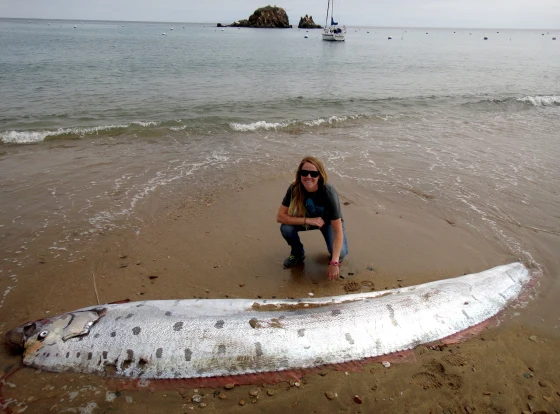
    An oarfish several meters long was found washed ashore on Catalina Island, California. The rare sighting of this ribbon-like fish always sparks public fascination, often linked to myths of sea dragons and the so-called “doomsday fish.” Photo: Reuters/Handout.

    The oarfish spends most of its life far from human eyes, dwelling at depths between 650 and 3,200 feet (200–1,000 meters). This twilight zone of the ocean is difficult to access, meaning people almost never encounter the fish in its natural habitat. Most of what we know comes from stranded carcasses or sick individuals that drift toward the surface.

    This scarcity fuels myths. Each time an oarfish appears, it sends waves of speculation. For example, in February 2025, a living oarfish was spotted off the coast of Baja California Sur, Mexico. Tourists recorded video footage that quickly went viral, with social media buzzing about omens of earthquakes and tsunamis. Marine biologists soon clarified that the sighting was unrelated to seismic events, but the emotional reaction highlighted the power this fish has on the human imagination.

    SEE ALSO  Why “Deadliners” Became Part of Indonesian Work Culture

    In Japan, the oarfish is steeped in cultural meaning. Known as ryūgū no tsukai, or “messenger from the sea god’s palace,” the fish is believed to appear before major quakes or tsunamis. Memories of the catastrophic 2011 Tōhoku earthquake, which was preceded by several oarfish sightings, only cemented this belief. Yet, scientists emphasize there’s no proven connection between the fish and seismic activity. Instead, factors like ocean warming, storms, or illness likely explain why oarfish sometimes stray into shallow waters.


    A Breakthrough in Ocean Science

    For centuries, the oarfish was known mainly through carcasses and myths. That changed in 2013, when Dr. Mark Benfield of Louisiana State University led a groundbreaking study using a remotely operated vehicle (ROV). For the first time, scientists recorded an oarfish alive in its deep-sea environment, later publishing their findings in the Journal of Fish Biology.

    The footage revealed a striking behavior: the oarfish often swims vertically, head pointed upward. Researchers believe this posture helps it spot tiny prey silhouetted against faint surface light. In other words, its ribbon-like shape isn’t just a bizarre quirk—it’s an evolutionary advantage. As Benfield explained, “Its body design allows it to feed efficiently in the deep ocean.”

    The ROV also showed that oarfish are far from sluggish drifters. Despite their immense length, they maneuver gracefully, using undulating waves along their dorsal fin to move steadily and conserve energy. This challenged the long-held assumption that oarfish were weak swimmers entirely at the mercy of ocean currents. Instead, they proved to be active, capable navigators of the deep.


    Two Main Species Across the Globe

    A team of researchers and snorkelers discovered a dead oarfish in the waters of La Jolla Cove, California, on Saturday, August 10, 2024. Photo: Michael Wang/The Scripps Institution of Oceanography via Phys.

    Though often spoken of as one creature, oarfish actually come in two recognized species. The giant oarfish (Regalecus glesne) is the most widespread, found in the Atlantic, Pacific, and Indian Oceans. This is the species that can surpass 36 feet and was captured on video by Benfield’s team. It remains the longest known bony fish on the planet.

    SEE ALSO  World Icons Have Been Here: Famous Celebrities Who Visited These Hidden Gems in Indonesia

    The second species, Regalecus russellii, is found mainly in Japanese and western Pacific waters. It is generally shorter—between 10 and 26 feet (3–8 meters)—but still enormous by fish standards. In 2020, Japanese researcher Dr. Shigeru Oka succeeded in artificially fertilizing oarfish eggs and documenting larval development, a scientific milestone that provided rare insights into the species’ early life stages.

    Some researchers have also described Regalecus kinoi, identified from Mexico in 2007, though most experts consider it synonymous with R. glesne rather than a distinct species. For now, the oarfish family is officially recognized as two major species: the giant cosmopolitan R. glesne and the Pacific-associated R. russellii.


    Between Myth and Science

    Despite scientific progress, myths still cling tightly to the oarfish. In Asia especially, the legend of the “doomsday fish” remains powerful. Given how seldom people encounter it, it’s easy to see why its appearance feels like an extraordinary event tied to larger forces.

    Marine biologists, however, urge caution. The supposed link between oarfish sightings and natural disasters is likely coincidence. Many other explanations exist: shifts in water temperature, ocean storms, pollution, or illness can all drive oarfish into shallower waters. In fact, most specimens found at the surface are weak or dying, not issuing warnings from the deep.

    Yet myth isn’t entirely harmful. In fact, it can help. Folklore draws attention to the mysteries of the ocean and sparks curiosity among the public. For journalists, educators, and conservationists, the oarfish is a perfect example of how legend and science can intersect. By blending cultural stories with hard facts, the fish becomes more than just a sea monster—it becomes a gateway to deeper discussions about marine ecology and conservation.


    An Ecological Player in the Deep Sea
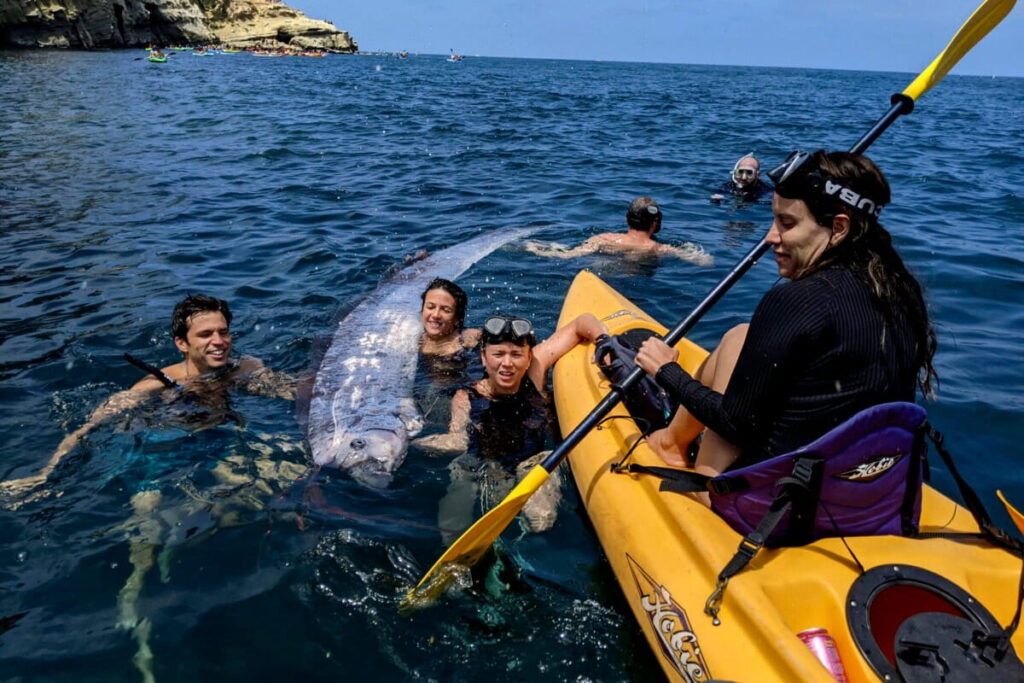
    A team of researchers and snorkelers discovered a dead oarfish in the waters of La Jolla Cove, California, on Saturday, August 10, 2024. Photo: Michael Wang/The Scripps Institution of Oceanography via Phys.

    Beyond its mystique, the oarfish serves a practical role in marine ecosystems. As a consumer of plankton and small crustaceans, it helps transfer energy from the ocean’s microscopic life forms to larger food webs. Studying its habits and diet offers scientists valuable clues about how the deep sea regulates energy cycles across the globe.

    SEE ALSO  The Music of Gamelan: Why German Composers Admire It

    This research is especially important because so much of the ocean remains a mystery. According to the Seabed 2030 project, as of mid-2025, only about 27 percent of the ocean floor has been mapped in detail. That leaves vast swaths of the deep uncharted and unexplored. The oarfish, therefore, is not just a biological curiosity—it’s a symbol of how much we still don’t know.

    At the same time, the oarfish’s ability to capture public fascination makes it a potential ambassador species for marine science. Its dragon-like appearance and doomsday myths can be used to promote interest in ocean exploration and research funding. By leveraging this intrigue, scientists and conservationists hope to unlock further secrets of the deep and highlight the urgent need to protect these ecosystems.


    Why the Oarfish Still Matters

    In many ways, the oarfish embodies the paradox of the deep ocean. It is both real and mythological, terrifying and harmless, elusive yet occasionally thrust into the spotlight. Every time it surfaces, people project fears, beliefs, and stories onto its appearance. And yet, behind all the legends lies a fascinating biological truth: this is a living, breathing piece of evolutionary wonder, adapted to survive in one of the planet’s harshest environments.

    For science, the oarfish offers insights into deep-sea life, energy transfer, and evolutionary adaptation. For culture, it offers stories that connect humanity to the mysteries of the ocean. And for conservation, it provides a charismatic face that can rally support for protecting one of Earth’s least understood ecosystems.

    So the next time a shimmering, ribbon-like dragon drifts up from the depths, perhaps the question isn’t whether it signals the end of days. Instead, it’s whether we’re willing to follow its trail into the uncharted blue, to finally understand what secrets the deep sea still holds.

    deep ocean exploration deep sea mysteries doomsday fish giant bony fish marine biology discoveries mysterious deep sea creatures oarfish oarfish Baja California oarfish conservation oarfish cultural meaning oarfish habitat oarfish Japan oarfish myth and science oarfish scientific research oarfish sightings ocean legends rare sea animals Regalecus glesne Regalecus russellii sea dragon
    Share. Facebook Twitter Pinterest LinkedIn Tumblr Email
    Previous ArticleLiving Fossil from the Cretaceous: Indonesia’s Coelacanth Caught on Camera
    Next Article The Making of Civet Coffee: Inside the Unique Journey of Kopi Luwak
    Editor Desk
    • Website

    Related Posts

    Economy

    Indonesia’s National Nutrition Agency Leadership Change Draws International Attention

    By Editor DeskJune 3, 2026
    Don't Miss

    Indonesia’s Biodiesel Shift: B50 Plan Put on Hold, Raising Questions for Global Palm Oil Markets

    By Editor DeskJanuary 14, 2026
    Disaster & Environment

    Elephants Help Clear Wooden Debris After Aceh Disaster

    By Editor DeskDecember 27, 2025
    Don't Miss

    Know the Types of Snakes in the Wild & What to Do If You Get Bitten

    By Editor DeskDecember 27, 2025
    Digital Life

    Gen Z in Indonesia and the Global “Escape Culture”: Why Many Are Saying #KaburAjaDulu

    By Editor DeskOctober 20, 2025
    Agriculture

    The Export of Indonesian Specialty Products: How Local Ingredients Are Becoming Global Brands

    By Editor DeskOctober 20, 2025
    Add A Comment
    Leave A Reply Cancel Reply

    Don't Miss

    Indonesia’s National Nutrition Agency Leadership Change Draws International Attention

    By Editor DeskJune 3, 2026

    Indonesia has attracted international attention following a recent leadership change at the National Nutrition Agency,…

    Indonesia’s Biodiesel Shift: B50 Plan Put on Hold, Raising Questions for Global Palm Oil Markets

    January 14, 2026

    Elephants Help Clear Wooden Debris After Aceh Disaster

    December 27, 2025

    Know the Types of Snakes in the Wild & What to Do If You Get Bitten

    December 27, 2025
    Top Posts

    Indonesia’s National Nutrition Agency Leadership Change Draws International Attention

    June 3, 2026

    Experience the Charm of Labuan Bajo’s Pinisi Boat Right Here in Lampung: Discover the Legendary Maritime Heritage of Indonesia

    June 30, 2025

    Must-Know: 5 Traditional Dances from Lampung You’ll Often Encounter

    June 30, 2025

    What to Do When You See a Snake: A Practical Guide for Everyday Life in Sumatra

    June 30, 2025
    Stay In Touch
    • Facebook
    • Twitter
    • Instagram
    • YouTube
    About Us
    About Us

    Saibumi International brings authentic stories, cultural depth, and off-the-radar destinations from Indonesia and the wider Asian region — crafted for readers who want more than surface-level travel and headlines.

    Facebook X (Twitter) YouTube Reddit
    Our Picks

    Indonesia’s National Nutrition Agency Leadership Change Draws International Attention

    June 3, 2026

    Indonesia’s Biodiesel Shift: B50 Plan Put on Hold, Raising Questions for Global Palm Oil Markets

    January 14, 2026

    Elephants Help Clear Wooden Debris After Aceh Disaster

    December 27, 2025
    Most Popular

    Indonesia’s National Nutrition Agency Leadership Change Draws International Attention

    June 3, 2026

    Experience the Charm of Labuan Bajo’s Pinisi Boat Right Here in Lampung: Discover the Legendary Maritime Heritage of Indonesia

    June 30, 2025

    Must-Know: 5 Traditional Dances from Lampung You’ll Often Encounter

    June 30, 2025
    • Home
    • About Us
    • Advertise
    • Contact Us
    © 2026 Saibumi International. SEO & Web by Dkonten Studio

    Type above and press Enter to search. Press Esc to cancel.