



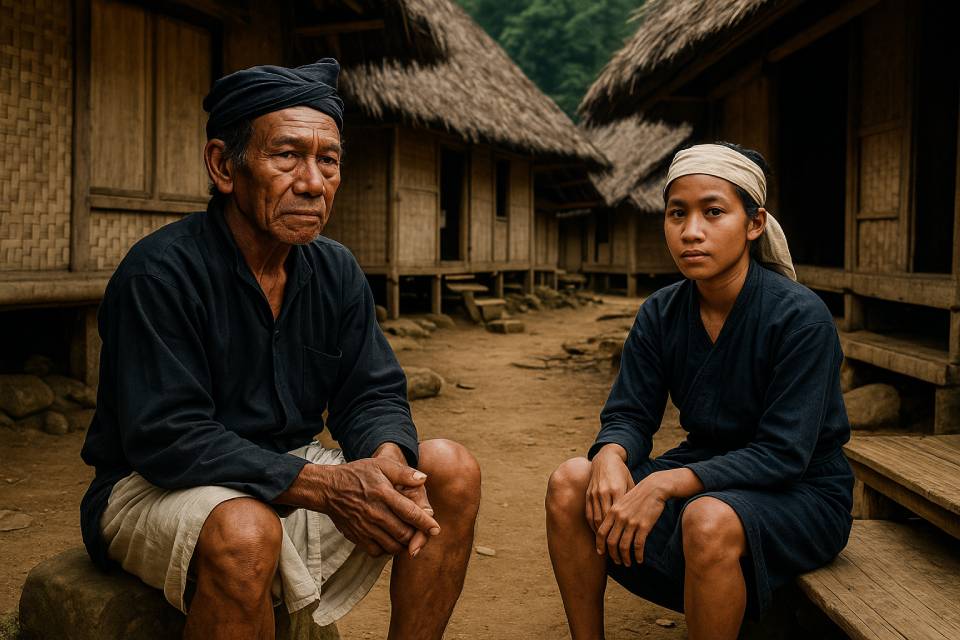
In a world where Wi-Fi is considered a basic need and notifications rule our daily lives, it’s almost unthinkable that entire communities exist — by choice — without access to the internet, electricity, or modern conveniences. But deep within the diverse archipelago of Indonesia, several indigenous tribes are doing just that.
They live without screens, social media, or even electricity — and not because they don’t have access, but because they choose to maintain a lifestyle that prioritizes balance with nature, tradition, and community.
Let’s explore the fascinating lives of the Baduy Dalam in Java and the Korowai in Papua, two remote tribes that remind us that disconnection might just be the real luxury.
Who Are the Baduy Dalam?
Hidden among the lush hills of Banten, West Java, the Baduy tribe is divided into two main groups: Baduy Luar (Outer Baduy), who accept some elements of modern life, and Baduy Dalam (Inner Baduy), who live in complete rejection of technology and modernization.
No Electricity, No Phones, No Vehicles
The Baduy Dalam live without:
- Electricity
- Mobile phones or internet
- Transportation (even bicycles are forbidden)
- Modern medicine or packaged foods
To visit them, you’ll need to walk — sometimes for hours — through the forest, cross bamboo bridges, and leave all your electronics behind. Cameras are strictly prohibited inside their sacred areas.
This is not just a lifestyle — it’s a spiritual commitment to pikukuh, their ancestral customary law that emphasizes simplicity, harmony, and purity.
A Life of Balance
The Baduy Dalam believe that any disruption to the natural world — like mining, deforestation, or modern construction — will lead to chaos in the human world. That’s why their homes are made of bamboo and palm leaves, their clothes are handmade without dyes, and their lives are centered around farming, weaving, and rituals.
They don’t even use soap or shampoo. Instead, they bathe in rivers using natural herbs and leaves.
“We don’t need phones. What we need is peace,” a Baduy elder once said.
And strangely enough, their serenity feels contagious.
High Above the Forest: Meet the Korowai Tribe
Now, let’s jump over 3,000 kilometers east to Papua, Indonesia’s easternmost province. Deep within the dense jungles near the border with Papua New Guinea live the Korowai people, one of the last known tribes in the world to build treehouses up to 30 meters high.
Treehouses in the Sky
The Korowai are known for their extraordinary homes built on towering stilts, high above the ground to avoid floods, insects, and — as the story goes — evil spirits. Some of their treehouses are so tall, they look like something out of a fantasy novel.
“When you sleep high, you see stars. When you wake up, the forest sings to you,” one local guide explained.
They rely on hunting, fishing, and gathering sago (a starch from palm trees), and until recent decades, had minimal contact with the outside world.
Guardians of Ancient Beliefs
The Korowai speak their own distinct language and have spiritual beliefs that govern their lives. One of the most mysterious aspects of their culture is the concept of khakhua — spirits believed to possess people and cause death. Certain taboos and rituals are performed to protect the community from these forces.
While some Korowai villages have been touched by tourism or missionaries, many clans still live completely off the grid, untouched by electricity, roads, or digital life.
Why They Choose Disconnection
Unlike many remote communities in the world who are eager to “catch up” with the modern age, both the Baduy Dalam and Korowai tribes actively choose disconnection.
Why?
- To preserve their traditions: Technology often brings cultural erosion. These tribes understand that once you let in the internet, you also let in foreign values, dependency, and distraction.
- To protect nature: They see themselves as caretakers of the earth. Electricity, vehicles, and construction are seen as threats to environmental balance.
- To maintain social cohesion: No scrolling, no isolation, no endless comparison. Life in these tribes is built on real conversations, face-to-face collaboration, and collective living.
In an ironic twist, what some might call “primitive” is actually a sophisticated cultural choice rooted in wisdom.
What We Can Learn from Them
While you might not be ready to ditch your phone and live in a treehouse, there’s a lot we can learn from Indonesia’s offline tribes:
1. The Power of Slow Living
When was the last time you spent a full day walking, talking, and simply existing? These tribes remind us that life doesn’t have to be rushed.
2. Nature Is Not a Resource — It’s a Relative
For the Baduy and Korowai, nature isn’t something to exploit. It’s something to live with. Imagine if the rest of the world treated rivers and forests as sacred — how different our planet would look.
3. Community Over Individualism
In tribal life, everyone plays a role. There’s no room for ego or isolation. You eat together, work together, survive together. It’s a refreshing contrast to the hyper-individualism of city life.
Final Thoughts
In a hyperconnected world where screen time is at an all-time high, the existence of communities like the Baduy Dalam and Korowai feels almost like a myth — and yet they are very real.
Their way of life challenges everything we think we need: Wi-Fi, apps, instant delivery, and digital validation.
Maybe — just maybe — true freedom isn’t found in faster downloads, but in slowing down, stepping outside, and reconnecting with the land beneath our feet.
