



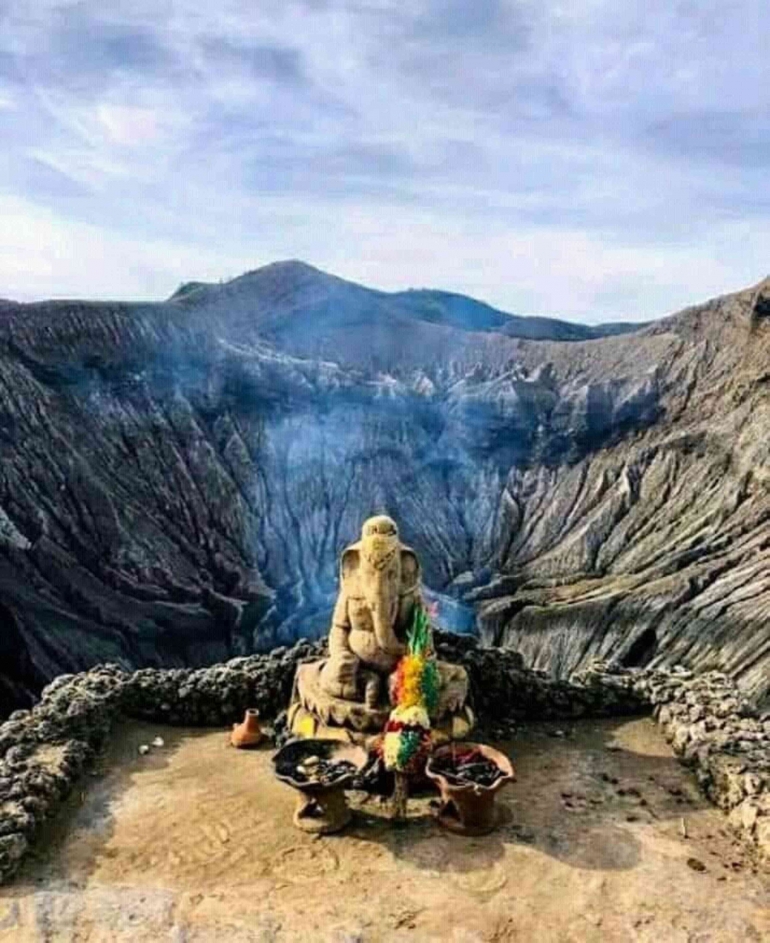
High on the slopes of Mount Bromo, one of Indonesia’s most famous active volcanoes, stands a centuries-old statue of Lord Ganesha. Surrounded by mist, volcanic ash, and the endless chants of ritual prayers, this stone deity has been a silent witness to the spiritual devotion, struggles, and resilience of the Tenggerese people for more than 700 years. It is not merely a relic of the past; it is a living embodiment of faith, culture, and the enduring bond between humans and the natural world.
The Sacred Heart of East Java
Located within Bromo Tengger Semeru National Park in East Java, the Ganesha statue sits at an extraordinary confluence of geology and spirituality. Mount Bromo, with its dramatic caldera and smoldering crater, is part of the Pacific Ring of Fire—a chain of volcanoes that defines Indonesia’s landscape and its people’s destiny. For the Tenggerese, however, Bromo is not just a volcano. It is a divine being, a place where gods, ancestors, and nature communicate with humanity.
The presence of the Ganesha statue on its slopes reinforces this connection. Ganesha, revered in Hinduism as the remover of obstacles, the lord of wisdom, and the patron of beginnings, plays a protective role here. Locals believe the statue helps pacify the volcano’s fury, shielding villages and farmlands from destructive eruptions. In this way, Ganesha is not just a deity carved in stone—he is the volcano’s spiritual guardian.
A Legacy Rooted in Majapahit
The story of how the Ganesha statue came to be in Bromo traces back to the fall of the Majapahit Empire in the 15th century. As Islam spread across Java, remnants of the Hindu-Buddhist kingdom fled to the highlands, seeking refuge in the Tengger mountains. These refugees, now known as the Tenggerese people, carried with them their rituals, language, and devotion to Hindu deities.
Among these deities, Ganesha held a special place. In the harsh volcanic environment, where eruptions and earthquakes were part of daily reality, Ganesha’s role as the remover of obstacles took on a profound meaning. Erecting his statue on Bromo’s slopes was both a plea for protection and a declaration of faith. Over the centuries, this statue has become one of the last surviving symbols of Majapahit’s spiritual heritage, preserved not in museums but in the living traditions of the Tenggerese.
Daily Offerings and Spiritual Practice
What makes the Ganesha statue remarkable is not just its age but its ongoing relevance. To this day, the Tenggerese bring offerings of flowers, fruits, incense, and symbolic items to its base. For them, these rituals are not empty gestures—they are essential acts of devotion to maintain harmony between humanity, the divine, and the volatile forces of nature.
Every morning, as the sun rises over the caldera, wisps of incense smoke mingle with the mist. The soft chants of prayers blend with the rumble of the volcano. These daily offerings are quiet affirmations that spirituality is not confined to temples—it lives on mountainsides, in the heart of a community that continues to honor its ancestors and its gods.
The Festival of Yadnya Kasada
The most dramatic expression of devotion to the Ganesha statue comes during the annual Yadnya Kasada festival. This ritual, held under the full moon of the twelfth month in the Tenggerese Hindu calendar, sees thousands of pilgrims trek to Mount Bromo. They bring with them offerings of crops, livestock, and other valuables, which they cast into the crater as a sacrifice to Sang Hyang Widhi Wasa, the supreme god.
Ganesha serves as the mediator in this ceremony, a bridge between the community and the fiery forces of the earth. For the Tenggerese, these offerings are not losses but investments in cosmic balance—ensuring that the volcano remains calm, crops grow, and their people survive. The festival also draws visitors from across Indonesia and the world, blending the sacred with the spectacular.
The Name and the Myth
The very name “Bromo” is a linguistic echo of its sacred roots. Derived from the Javanese pronunciation of “Brahma”—the Hindu god of creation—the mountain has always been seen as a spiritual axis. In this light, placing a statue of Ganesha on its slopes is not coincidental but symbolic. It signifies continuity, the coexistence of creation and destruction, and the eternal cycle of nature that governs life on the volcano.
Myths abound around the statue itself. Local legends speak of moments when the statue mysteriously vanished, only to reappear later. Villagers interpreted such events not as theft but as spiritual acts of purification carried out by unseen forces or through the guidance of their shamans. These stories only deepen the aura of mystery surrounding the statue, making it not just an artifact but a living legend.
The Tenggerese Identity and Cultural Survival
The Tenggerese people are the living heirs of Majapahit’s cultural legacy. Their language, rituals, and customs have survived for centuries, insulated by the isolation of the mountains. The Ganesha statue plays a vital role in their identity, reminding them of who they are and where they come from. It is a cultural anchor, rooting them in their ancestral past even as the modern world presses in.
Yet, the irony remains that while the Ganesha statue is venerated locally, many treasures of Majapahit remain neglected or lost. The Bromo statue is one of the few visible and actively revered links to this ancient empire, raising questions about how Indonesia preserves—or fails to preserve—its vast cultural heritage.
Tourism, Respect, and Challenges
Today, Mount Bromo is one of Indonesia’s most visited destinations. Tourists flock here to witness the otherworldly sunrise over the caldera, to hike to the smoking crater, and to marvel at the rugged beauty of the landscape. Along the way, many encounter the Ganesha statue, often unaware of its deep spiritual significance.
This lack of awareness sometimes leads to disrespectful behavior—visitors climbing the statue for photos, leaving trash nearby, or treating the sacred space as a tourist attraction rather than a shrine. For the Tenggerese, such acts are painful reminders of how fragile their cultural heritage has become in the age of mass tourism.
Balancing tourism and preservation is not easy. On one hand, tourism brings economic benefits to the community. On the other, it risks commodifying what should remain sacred. The future of the Ganesha statue depends on finding a sustainable balance—where visitors can appreciate its cultural value without undermining its sanctity.
Why Preservation Matters
Preserving the Ganesha statue is not just about protecting a piece of stone. It is about safeguarding layers of meaning and history:
- Historical value: The statue is tangible evidence of Majapahit’s legacy and the endurance of Hindu traditions in Java.
- Spiritual significance: It remains an active site of worship, not a forgotten relic.
- Cultural identity: For the Tenggerese, it is a vital marker of who they are.
- Ecological harmony: It embodies the balance between humans and a volatile natural environment.
- Educational potential: The site offers immense opportunities for learning about religion, anthropology, and the relationship between culture and nature.
Without preservation, all these layers risk being eroded—not by volcanic eruptions, but by neglect, ignorance, and unchecked commercialization.
A Call for Holistic Preservation
Protecting the Ganesha statue requires more than fencing it off or putting up signs. A holistic approach is needed:
- Legal protection: Recognition as a cultural heritage site with enforced protections.
- Community involvement: The Tenggerese must lead preservation efforts, not be sidelined by external interests.
- Visitor education: Clear information for tourists about the statue’s sacred nature and guidelines for respectful behavior.
- Academic research: Ongoing archaeological and anthropological studies to deepen understanding of the statue’s origins and meanings.
Only by combining these efforts can the Ganesha statue continue to stand as a symbol of resilience, faith, and cultural survival.
A Symbol for the Modern World
In a rapidly changing, globalized era, the Ganesha statue on Mount Bromo serves as a reminder that not all wisdom is written in books or stored in archives. Some of the most profound lessons are carved into mountainsides, kept alive through rituals, and passed down in oral traditions. The statue tells us that faith can endure for centuries, even in the shadow of a rumbling volcano.
It also challenges us to reflect on our own relationship with nature. The Tenggerese do not seek to dominate or exploit the volcano—they seek to coexist with it, to honor its power, and to live in balance with its cycles. In a world facing ecological crises, this worldview carries urgent relevance.
Conclusion: The Eternal Guardian
The Ganesha statue on Mount Bromo is more than an artifact. It is a guardian, a storyteller, and a living bridge between past and present. It embodies the resilience of the Tenggerese people, the enduring legacy of Majapahit, and the delicate harmony between humans and nature.
As we stand before it—whether as pilgrims, scholars, or tourists—we are reminded that preservation is not just about stone and history. It is about honoring the values that make us human: reverence, respect, and the ability to coexist with forces greater than ourselves.
In Hindu belief, Ganesha removes obstacles and clears the path forward. Perhaps, in our collective effort to preserve sacred sites like this one, we too can remove the obstacles of ignorance, apathy, and exploitation. In doing so, we ensure that the Ganesha statue will continue to stand watch over Mount Bromo—not just as a relic of the past, but as a beacon for the future.
