



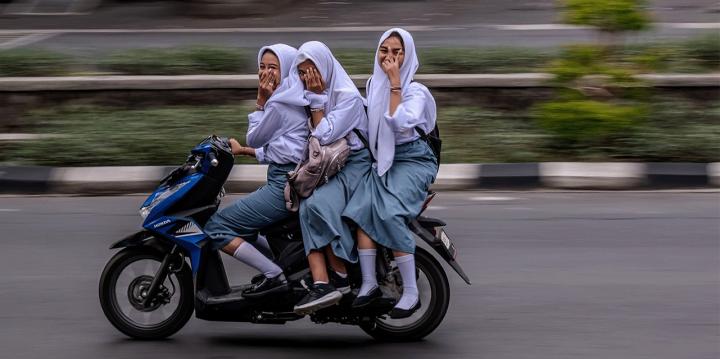
If you’ve spent more than a week in Indonesia, chances are you’ve seen it with your own eyes — a motorcycle carrying not one, not two, but three people zooming through traffic like it’s the most normal thing in the world.
A kid sandwiched between two adults. A family of four squeezed onto one bike. Groceries hanging off the handlebars. Welcome to the streets of Indonesia, where “bonceng tiga” — riding three on a motorcycle — is as common as roadside food stalls.
But here’s the thing: it’s totally illegal.
Everyone Knows It’s Dangerous, But…
Most people are aware that overloading a motorcycle is unsafe. Motorbikes are designed for two people at most — the driver and one passenger. Anything more than that messes with the balance and handling, making it harder to maneuver or stop in emergencies.
Even a small bump in the road or a sudden swerve can become a major hazard. And let’s not forget: most riders don’t wear proper helmets, especially the third rider — often a child.
And yet, the habit continues. Why? Mostly out of convenience. For many families, a motorcycle is the only vehicle they own. If they need to go somewhere, they make it work — legal or not.
What the Law Actually Says
Indonesia’s traffic laws are crystal clear on this one. According to Law No. 22 of 2009 on Road Traffic and Transportation, specifically Article 106 paragraph (9), it’s forbidden to carry more than one passenger on a motorcycle — unless there’s a sidecar attached.
If you break that rule? You could be slapped with a fine of up to Rp250,000 (about $15) or face a month in jail under Article 292 of the same law.
Not enough? There’s also Government Regulation No. 55 of 2012, which further emphasizes that motorcycles are only allowed to carry one passenger. No exceptions.
But here’s the problem: laws without enforcement are just… words on paper.
A Culture of “Asal Jalan”
Indonesians have a popular saying when it comes to things like this: “asal jalan” — as long as it works, it’s fine. It reflects a deeply rooted mindset where practicality often wins over rules, especially when enforcement is inconsistent.
Sure, police occasionally run checks and issue fines, but the sheer number of violators makes it nearly impossible to police every instance. Many people see others doing it and think, “If they can, why not me?”
More Than Just a Traffic Violation
This isn’t just a technicality. Riding three on a bike is a real public safety issue. Every year, thousands of traffic accidents in Indonesia involve motorcycles. Many are caused by overloading, poor maintenance, or lack of protective gear.
It’s not uncommon to hear news reports about fatal accidents where children were thrown off overloaded motorcycles — often because they weren’t wearing helmets or sitting securely.
What makes it worse is that many of these incidents are entirely avoidable.
So, What Needs to Change?
Changing habits isn’t easy. It takes more than just writing laws and hoping people follow them. Here’s what can help:
- Better enforcement: Regular checks in high-traffic areas can deter habitual violators.
- Public awareness campaigns: Especially targeting parents who often put kids in risky situations without realizing the long-term consequences.
- Affordable alternatives: Public transport still isn’t reliable in many parts of Indonesia. If people had easier access to buses or shared rides, maybe they’d think twice before loading up the motorbike.
- Education at the community level: Sometimes the most effective change comes from peer influence — neighbors, local leaders, or school programs reminding people of the risks.
Final Thoughts
Breaking the law might seem like a small thing — especially if “everyone’s doing it.” But when it puts lives at risk, it’s more than just bending the rules.
Riding three on a motorcycle may feel like a shortcut today, but it can easily lead to heartbreak tomorrow. It’s time to stop normalizing what’s clearly dangerous — and illegal.
Because safety shouldn’t be optional. And the law? It’s there for a reason.
